Big, rural backyard firepits and campfire cooking on your own property can be remarkable and even eco-friendly group entertainment
Copyright National Lilac Publishing, LLC
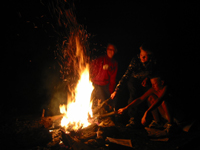
Bonfires on our farm were one of my most cherished group activities when raising our kids in the country. Guests would just “stare” into our blazing backyard firepit and not want to leave. Our town friends loved the idea of campfire cooking right from our own acreage.
Fire, when harnessed responsibly, can soothe and draw out the best in us. Rural bonfires can be enjoyed in any season that fires are allowed. A flickering flame, laughter, friendship, and the radiant heat of an open air blaze become a gathering to remember.
Making bonfires true group activities
Allow everyone involved in your bonfire gathering to contribute in some way. This makes it more “their” bonfire:
- Even young kids can help build a pile of crumpled recycled black and white newspaper used to help start the fire.
- Families can make fire starters together ahead of time by embedding a
wick into pine cones then dipping them into soy wax. Soy wax cleans
easily and doesn’t leave a residue for those with more permanent
backyard firepits who want to keep things tidy. They can fill paper egg
carton sections half full with pure wood sawdust and pour warm soy wax
into the sections. When hardened, they can cut the sections apart for fire
starters.
- Guests can contribute eco-friendly firewood (see below).
Eco-friendly bonfires without killing trees -- modern methods and old European secrets
- Each time you enjoy a large outdoor flame with guests, provide a place for donations to the
Arbor Day Foundation,
which uses it to help replant the country’s national forests that clean
the air and add to the world’s supply of treed eco-systems. Or instead
of asking for a direct donation, hold a fire-lit auction to add fun to
the bonfire gathering and collect money to donate.
- Use ecologically harvested firewood. If your farm doesn’t have its own woodlot, secure local sustainably harvested firewood.
- It's great to get wood from “coppiced” trees when possible. Coppicing means harvesting a tree in a manner that never kills it.
It sprouts again from the trunk and regrows. Not only that, when it's
coppiced, it's roots expand and sequester more carbon into the soil than
before. It’s an old European forest management method used for
centuries to harvest wood products while keeping the forests alive and
well. Coppicing works on many deciduous trees, which is a bonus, because
the best wood for fire is dried hardwood which comes from deciduous
trees, softwood being mostly the evergreens.
- Burn hardwoods that have been properly dried, or cured. Deciduous
trees are all considered hardwoods, although some are denser than
others. Avoid the softwoods, which are mostly evergreen conifers, when
possible. But even if burning softwood,
avoid burning it green and uncured. This produces much more polluting
smoke. Plus, it’s inefficient as far as giving out
heat and flame, and is not as warm because much of the heat is used to
drive off the water.
- Plant your own mini backyard woodland or even a single tree of your
own that can eventually be coppiced for future bonfire wood needs, and
offsets carbon emissions. The Arbor Day Foundation offers "Backyard
Woods," a small guide that shows how to plant a safe and earth enhancing
forest for owners of one to 10 acres. According to the Foundation, 49
percent of the earth’s forests are in private ownership, and those that
own backyard sized woods make up 60 percent of all USA private forest
landowners. Smaller parcels of wooded areas individually and
collectively make a big impact on the planet.
A secret to making smoke stop following you around
Because of an air vacuum effect, smoke on windless days from outdoor bonfires seeks solid
objects and moves away from air pockets. If a group stands to the east
of the fire on a windless night, the smoke will eventually go east. If
they move to the west, the smoke will follow them. If possible, have a fireproof solid object next to one small section of the bonfire to give the smoke its solid object its seeking, so it can flow away from people.
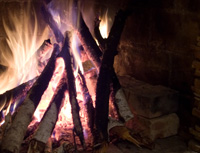
Rural backyard firepits
There are beautiful backyard firepits to purchase, and custom-made ones
can be stunning. But, rural firepits for big bonfires are sometimes
temporary and built from year to year in different places.
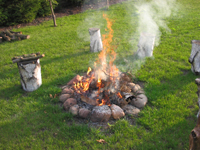
-A section of a large, toxin-free metal tube can be secured into the ground to hold the fire within.
-Properly fired bricks can be good for surrounding bonfires.
- Some stones work well, but different stones react differently to flame. Sandstone withstands heat pretty well. Do not use just any stone... SOME CAN BURST FROM THE HEAT! See below:
!!!Some types of river rock can even explode! Use caution
Limestone, basalt, shale and granite can crack or disintegrate.
Some people use an inner lining of brick and an outer ring of stone more for decoration if
they’re not sure what type of stone they have. Check with your local fire district if uncertain.
Turning traditional bonfires into biochar production gatherings, and other thoughts on carbon emissions.
As methods for making biochar at home grow, some may want to make biochar with friends and neighbors instead of holding a regular camp fire or bon fire. Making biochar often calls for just a short term fire that's rather quickly put out to let the burning material smolder, so recreational activities would be different than for a regular longer burning fire. But just like apple pressing gatherings and maple sugar harvesting of long ago, coming together for a shared work project that results in a valuable product can bring rewards of its own.
Biochar gatherings can offset the concern of carbon emissions from regular campfires and bonfire.
Also, for any outdoor fire, burn only dry untreated wood as mentioned above, which cuts back on emissions.
As well, make the bonfires shorter, smaller and less frequent.
Campfire cooking
Watch out: campfire cooking can become addictive.
- A cooking area somewhat apart from the main bonfire can be carved out
and designated for hot coals as they become available. You can use it
for holding items over to roast, or with a firepit grill.
- You may want to obtain a utensil called a coal scoop for gathering the hot coals if you think outdoor cooking will be a
major part of your bonfires. It’s sort of like a kitty litter scoop only it’s fireproof and the best ones’ handles won’t
heat up and burn your hands.
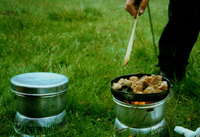
- For flavorful campfire food, cut five inch (or so) twigs and thin
branches from your fruit tree prunings, soak them in water for an hour,
and toss a few over your hot cooking coals to deliciously flavor foods
held over for roasting or cooked over them with a firepit grill.
- For lighter, less elaborate fireside snacks, consider a twist on the
typical roasted marshmallows by roasting heirloom apples or using a
handheld popcorn popper made for campfires.
See also our article on cooking outdoors.

- Heirloom apples are delicious roasted whole. Sweet Sixteens have a natural spicy aroma that makes them a real roasted treat. Old English Russets are also rich with delicious flavor undertones. Stick a long roasting fork into an apple and cook it over hot coals until the skin burns and the apple seems to whistle from the inside. Remove it from the heat. When cool enough, peel off the skin and eat.
- Libraries are loaded with more ideas on campfire cooking: from
burying potatoes into the coals to making fireside cornbread and wild
berry tarts. You may never want to cook inside again!
Safety: As wildfire numbers grow...
Fire permits are sometimes needed no matter what time of year even in rural areas, and there are important, necessary fire bans in certain locations during certain times of the year.
This article is for those in locations where outdoor fires are allowed under the right conditions. In some locations, especially urban, no outdoor fires of any kind are ever allowed.
Fire bans can change from season to season. So contact your closest fire department for requirements
concerning outdoor fires before any type of burning. They can also provide a list of updated fire safety
instructions that are both general and specific to the
landscape of your local area.
Test and re-test that you have ample pressurized water from a hose to immediately extinguish any fire, and also request from local fire authorities which type of fire extinguisher you should have on hand (such as Class A, or all classes combined...)
_______________
Enjoyable outdoor fires are a great "Agritourism" draw for bringing people to your farm or rural area for fun experiences in a
manner that helps the farm or rural community prosper financially.
You may also be interested in

